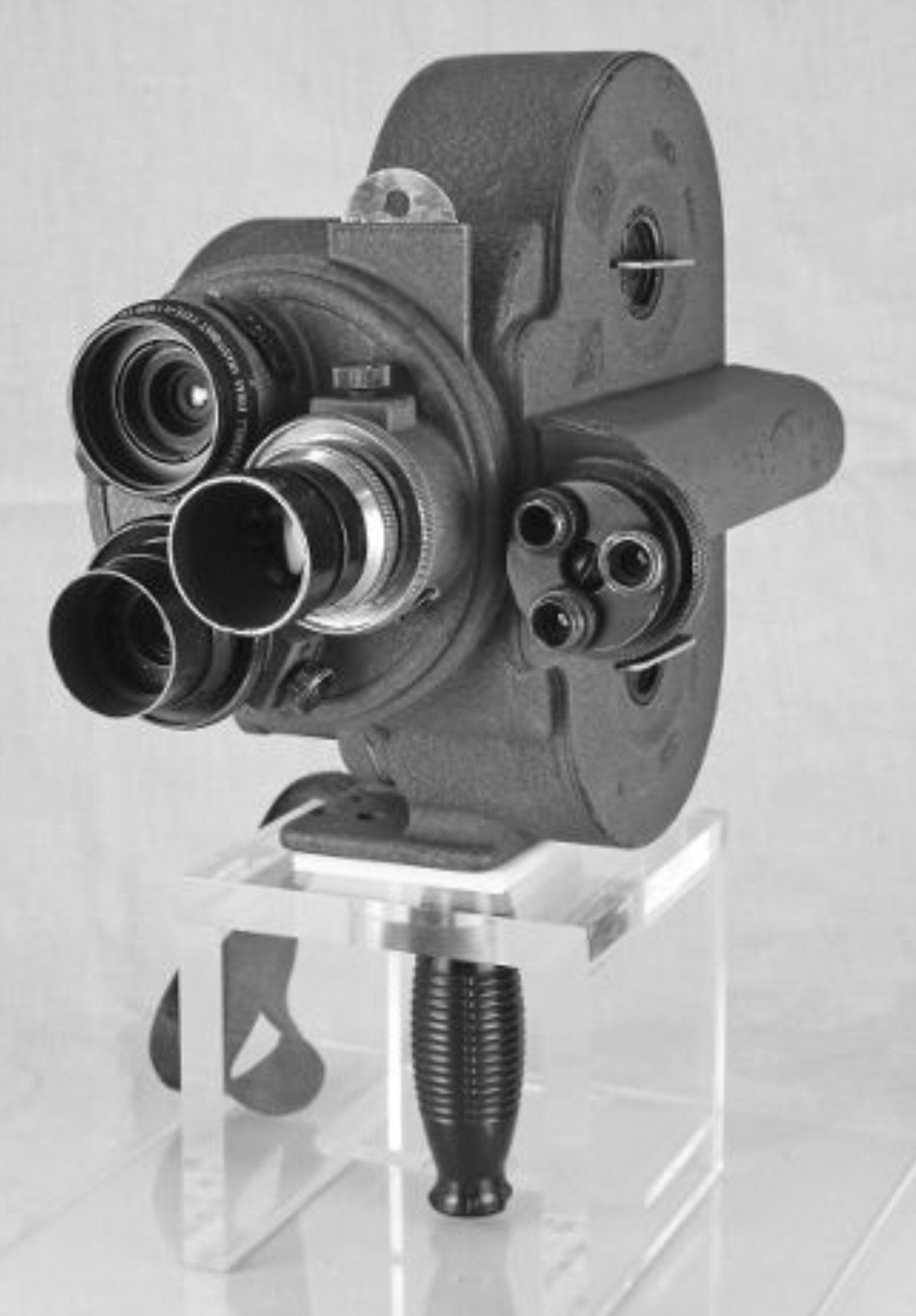
A 16mm idea, scaled up
Bell & Howell spent the first two decades of the century building the opposite of a portable camera. The Chicago firm's professional gear was heavy, precise and designed to sit still; its perforators and printers set the standards the industry measured itself against. Then in 1923 the company released the Filmo 70, a spring-driven 16mm camera small enough for an amateur to carry, and discovered it had built something more interesting than a toy.
The Eyemo, which arrived in 1925, was that idea scaled up to professional film. It took standard 35mm negative, the same stock the studios shot on, and packed it into a body a cameraman could hold to his eye and run with. For many years it was simply the most compact 35mm motion picture camera anyone made. Everything that followed from it — the newsreels, the war footage, the first films of several famous directors — comes down to that one decision: professional gauge, amateur ergonomics.
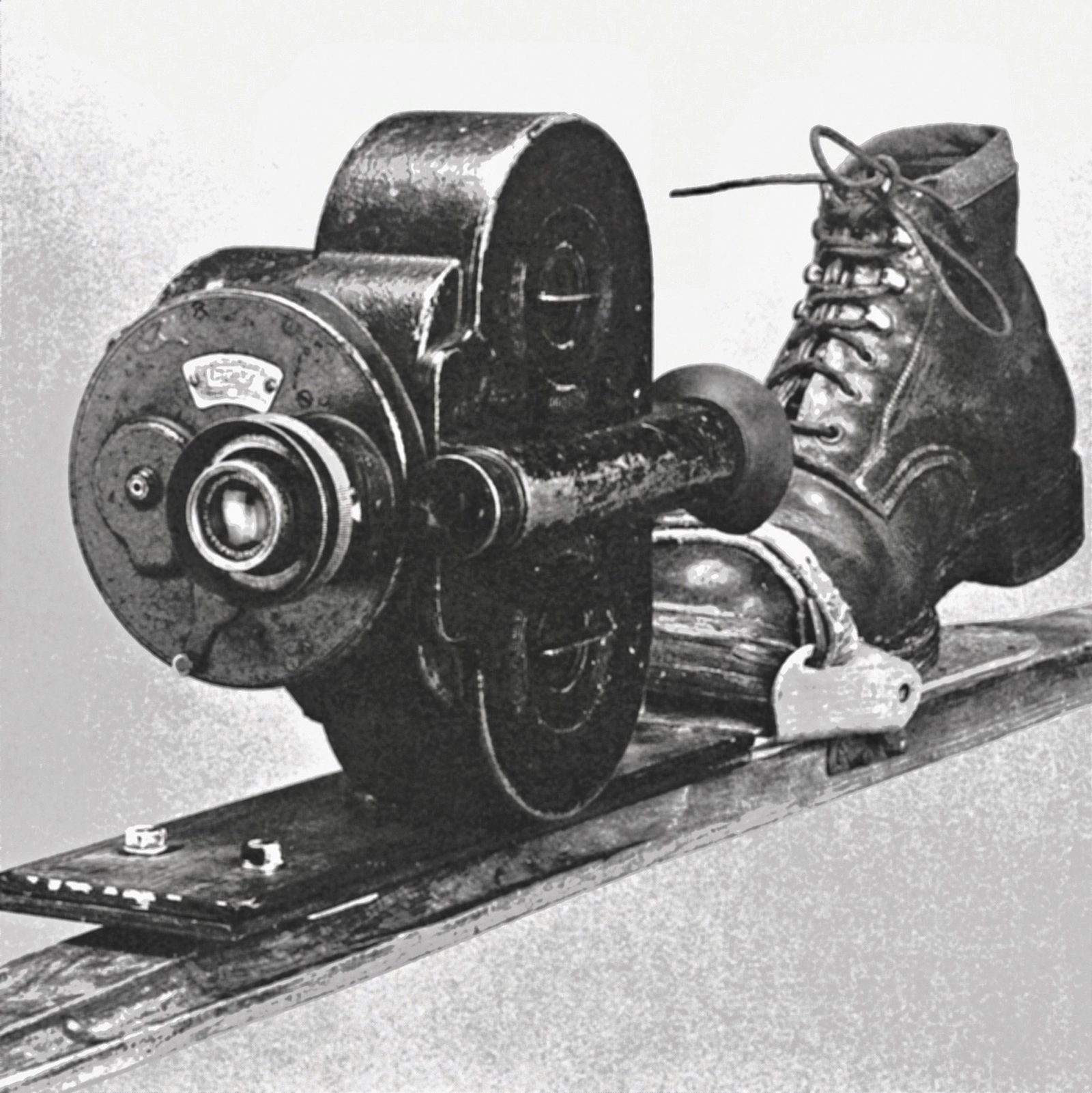
One wind, one shot
Inside was a clockwork spring motor. You wound it with a folding key on the side, and it drove the movement for a burst before running down; a full wind gives you something in the region of twenty to thirty seconds at sound speed. There was no battery, no cable, no motor whine, and in a pinch the camera could be hand-cranked instead. Film came on a 100-foot daylight-loading spool that dropped into the body, which works out to roughly a minute of running time before you reload.
That is a brutally short leash by modern standards and it shaped how people shot. An Eyemo operator learned to find the shot before rolling, because the spring did not forgive hesitation. The discipline shows in the footage: Eyemo material tends to be decisive, framed on instinct, cut off abruptly. Many bodies carried a three-lens turret that let the operator spin from wide to long without opening anything, which mattered when you were lying in mud or hanging off a vehicle and had no intention of changing a lens by hand.
The rest of the design is just toughness. A cast body, a reflex-free optical finder, controls big enough to work in gloves, and almost nothing on it that a drop would break. It is the only camera in this series you could reasonably describe as expendable, and that turned out to be the point.
The war camera
Newsreel outfits took to the Eyemo immediately, because it was the first 35mm camera that could keep up with a running story. The military took to it for the same reason and on a far larger scale. Eyemos became standard equipment for Allied combat camera units, and a great deal of the surviving motion picture record of the Second World War — landings, bombing runs, advances through ruined towns — came back on 100-foot Eyemo spools. The War Department issued its own manuals for the camera. Variants were built for gun cameras and bomb spotting, and surplus bodies from that era still circulate today.
It stayed in service a long time. Combat cameramen were still shooting Eyemos in Vietnam, four decades after the design was introduced, which is a run almost nothing in this field matches. The camera's virtues under fire were the same ones that made it useful in peacetime: no power, no noise, nothing to set up, and a body that survived being thrown into the back of a vehicle.
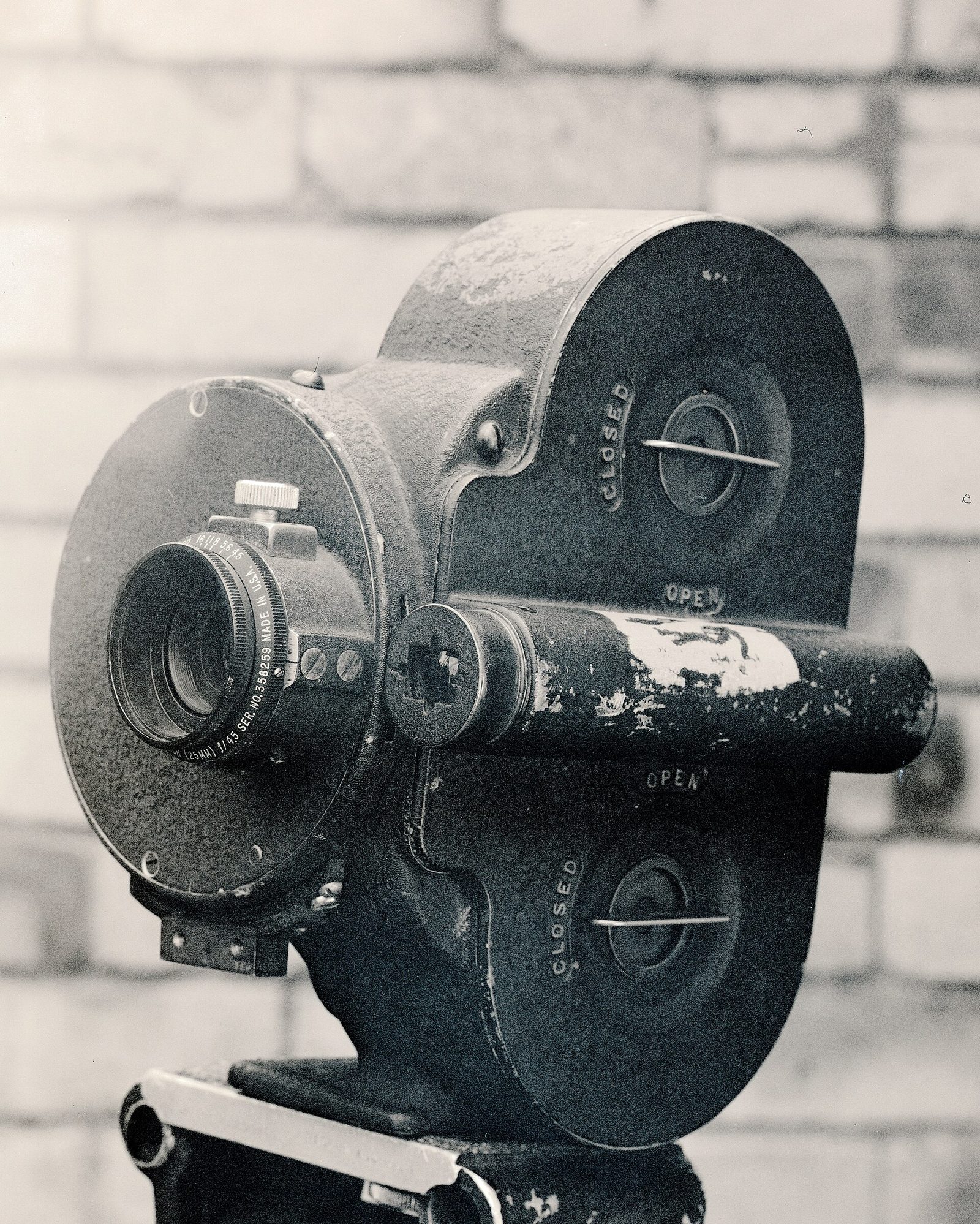
Kubrick's first camera
If you were making a film without a studio behind you in the middle of the century, the Eyemo was very often how you did it. Stanley Kubrick shot Day of the Fight (1951), his first film, on rented Eyemos loading 100-foot spools of black-and-white negative, working handheld and frequently shooting the boxer from below while a second camera covered from a tripod. He went back to the Eyemo for parts of Fear and Desire two years later, alongside a rented Mitchell NC for the more controlled work.
That pairing — a Mitchell for the setups you can plan, an Eyemo for everything else — recurs constantly in the period. The Eyemo was the camera you took to the places a crew could not follow: moving vehicles, crowds, rooftops, anywhere the shot had to be stolen rather than staged. It gave a generation of filmmakers a way into 35mm that did not require a studio's permission, which is a line that runs directly forward to the DV camcorders and DSLRs that did the same job later.
Still working, and still cheap
The Eyemo never really retired; it changed jobs. Productions still use them as crash cameras, the body you put in a position you expect to destroy — inside an explosion, under a car, dropped from a height — because it needs no power, runs on a spring, and costs a fraction of anything else that takes 35mm. Requiem for a Dream used an Eyemo adapted for Nikon lenses for its body-mounted point-of-view shots, which is a perfectly modern use of a camera designed in 1925.
For anyone shopping, this is the rare entry in this series you can actually afford. Surplus and ex-newsreel Eyemos turn up regularly, usually in the few hundred to low four figures depending on whether you get a single lens or a working turret, the condition of the spring, and whether the original lenses are still with it. Run the motor before you buy and listen for it slowing unevenly, which points to a tired or gummed spring; check the gate and the pressure plate for scoring, since decades of grit do real damage; and look hard at the turret lock if the body has one, because a turret that will not seat properly puts your lens out of register. Film and processing cost more than the camera will, which is the usual arithmetic with 35mm.
What it left behind is a whole category. The idea that a professional-format camera could be small, battery-free and cheap enough to risk is now so ordinary that it is hard to see as an invention, but somebody had to build the first one. Every crash cam, every action-mounted body, every camera bought specifically because losing it would not end the production, traces back to a spring-wound box from Chicago.