Where it came from
The Cameflex belongs to a small family of French inventions that rearranged who could make a movie and where. Its designer was André Coutant, who joined the Éclair company in 1939. Through the war years the French industry was cut off from much of the foreign equipment it relied on, and Éclair, the old Paris firm that had built cameras since the silent era, turned to a problem that studio cameras had never solved: a 35mm camera that one person could carry, point and reload without a crew of assistants.
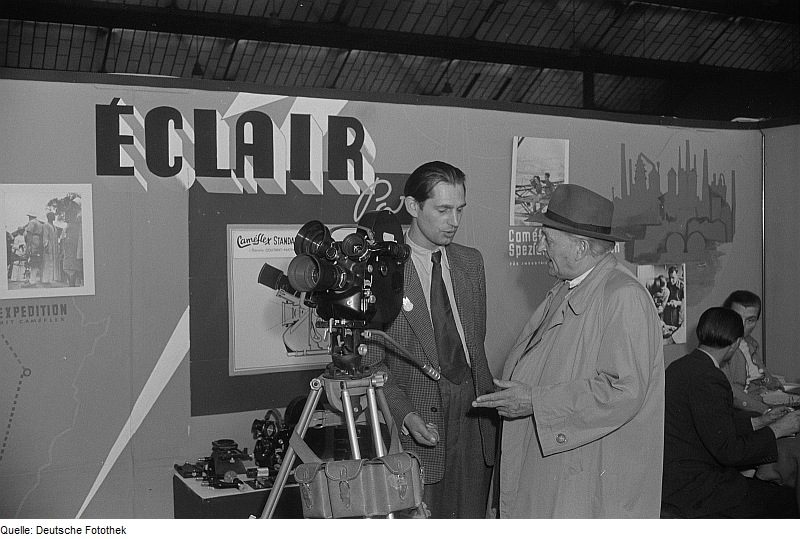
Coutant's first answer was a small prototype often called the Camérette, designed around 1946. Éclair put the production camera on sale in 1947 as the Caméflex, spelled Cameflex in English, and in the United States it was marketed under the name Camarette. By the time the French industry was rebuilding, the machine already looked like nothing else on a set. It was a compact box with a rotating turret of lenses on the front, a viewfinder on the side and a magazine perched on top.
What made it different
A studio camera of the 1940s, such as the Mitchell BNC, was a refrigerator-sized instrument that lived on a heavy tripod and inside a soundproof blimp. The Cameflex was designed from the opposite direction. It was electrically driven, ran at speeds from roughly 8 to 48 frames a second, and carried a three-lens turret so that a cameraman could swing from a wide lens to a long one without stopping to change glass.
The viewing system mattered as much as the size. The Cameflex used a reflex mirror shutter whose opening could be adjusted between about 35 and 200 degrees, which let the operator see through the taking lens and also change exposure without touching the iris. The viewfinder could be rotated around the camera body and locked, so the operator could frame a shot from the shoulder, the hip or a cramped car interior. The film rode in an easily interchangeable 400-foot coaxial magazine, which meant a reload was a matter of seconds rather than minutes.
Éclair kept widening the system rather than redesigning it. An underwater housing, the Aquaflex, appeared in 1949. In 1950 came a soundproof case, the Caméblimp, and the camera gained the ability to run different film formats. The Cameflex was never a single object so much as a kit that a small production could build around itself.
Who used it and what they shot
Newsreel crews took to it first. Movietone News, which supplied newsreels to British cinemas from 1929 to 1979, used the camera professionally. The Cinémathèque française also records that Soviet cosmonauts trained with one, making it among the first film cameras associated with spaceflight.
But the film that made its reputation was Breathless. In 1959 and 1960 Jean-Luc Godard and cinematographer Raoul Coutard shot on the streets of Paris with a Cameflex, working without a large lighting package and with a handheld camera that could follow actors through traffic and into cafés. It was loud, to the point that most of the dialogue had to be recorded again afterwards, but nobody who saw the picture mistook the trade-off. The camera had changed the grammar of the shot. The same year the Cinémathèque lists Truffaut's The 400 Blows among the Cameflex's films, and it also credits the camera with work on Orson Welles's The Trial and, much later, with footage on Apocalypse Now. The pattern is consistent: when a director wanted energy, speed or a lens in an awkward place, the Cameflex was the practical choice.
That is what people mean when they say the French New Wave was made possible by equipment. The directors had ideas, but the Cameflex and its descendants gave them a way to shoot those ideas cheaply, on location.
Its rivals and what replaced it
The natural rival was the Arriflex 35, introduced in Germany in 1937, which also combined a reflex mirror with a compact body. The two cameras divided the world between them for years. The Arriflex was more rugged and became the camera that cinematographers trusted in conflict zones; the Cameflex was more flexible, with its turret, its adjustable shutter and its large accessory range. Neither could easily record sound in sync, and both were noisy until blimped.
Éclair's own successors carried the idea into 16mm. The NPR, introduced in the early 1960s, was a quiet, sync-sound 16mm camera that documentary teams adopted for cinéma vérité, and the lighter ACL followed in 1971. The photograph at the top of this article shows an Éclair 16mm camera of that later generation rather than a Cameflex itself, which gives a sense of the family resemblance: the same rotating turret, the same top magazine, the same insistence that a camera should be something a person wears. In 1972 Jean-Pierre Beauviala founded Aaton in Grenoble, and the lightweight ergonomic cameras that company built draw directly on the lineage that Coutant had started. By then, the Cameflex's central idea had become so standard that nobody needed to name its source.
Why it still matters
Everything we now take for granted about handheld filmmaking carries some Cameflex in it: the idea of a reflex camera light enough to carry, the interchangeable magazine, the rotating viewfinder, the modular accessory system. The camera also taught producers an economic lesson. Once a single operator could capture a usable 35mm image on location, the argument for shooting everything in a studio began to weaken, and a movement that put the camera in the street was waiting for its equipment.
On the used market today
Cameflexes still turn up on the secondhand market, usually as a camera body with a magazine and a few lenses, sometimes as part of a larger kit with blimp, motors and cases. Prices vary widely with configuration and condition, so it pays to ask exactly what is in the box. Many survive in working order because the mechanism was well made and simple, but they are old machines. Before buying, check that the mirror shutter moves freely and holds its adjustment, that the turret indexes cleanly and the lenses seat properly, that the movement pulls film smoothly, and that the motor and any power cable are sound. Synchronous motors and original accessories are harder to find than the camera body, and a body without them is a tougher project than it looks. Used in the right hands, a well-maintained Cameflex is still a perfectly capable 35mm camera, and for collectors it remains one of the most historically important handheld cameras ever made. Ground Glass lists dealers who handle vintage film cameras if you want to see what is currently available.