The Largest Frame in Cinema
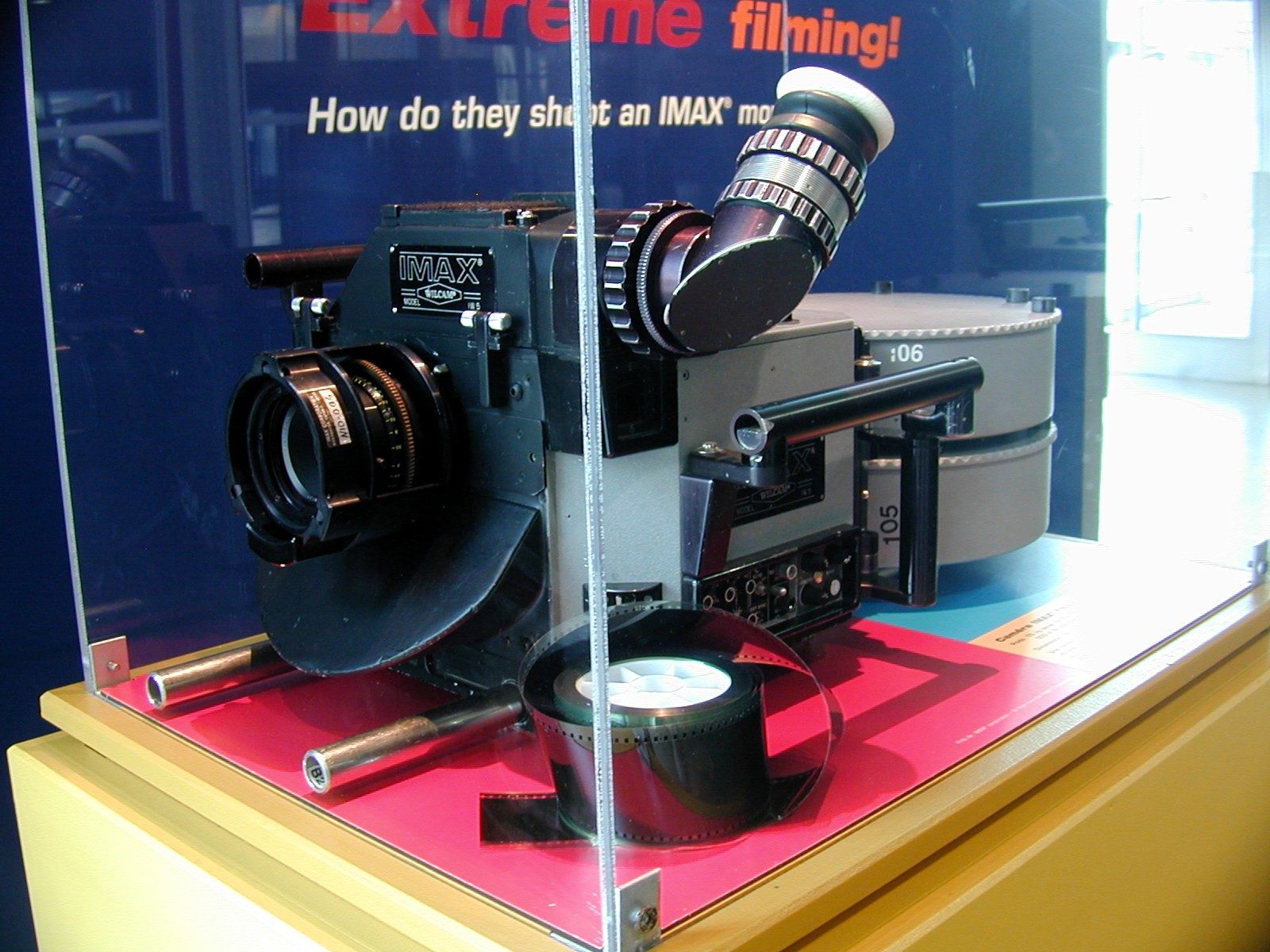
Every format in this series has a number attached to it, but none is as blunt as the one that defines IMAX. Fifteen perforations. Standard 65mm production film runs vertically through a camera and exposes five perforations per frame. IMAX turns the same stock on its side and pulls it horizontally, exposing fifteen perforations for each image. The negative is roughly 70 by 48 millimetres, about three times the area of 5-perf 65mm. No larger moving-picture frame has ever been in regular commercial use.
The format was born in Canada. Graeme Ferguson, Roman Kroitor, Robert Kerr and William Shaw had all been involved with multi-screen experiments at Expo 67 in Montreal and wanted a single-projector system that could fill a wall without seams. The company they founded, Multiscreen Corporation, would become IMAX Corporation. Their first public film, Tiger Child, directed by Donald Brittain and produced by Kroitor and Ichi Ichikawa, premiered on 15 March 1970 in the Fuji Group Pavilion at Expo 70 in Osaka, playing on a loop to audiences carried through the theatre on a rotating platform.
The Rolling Loop
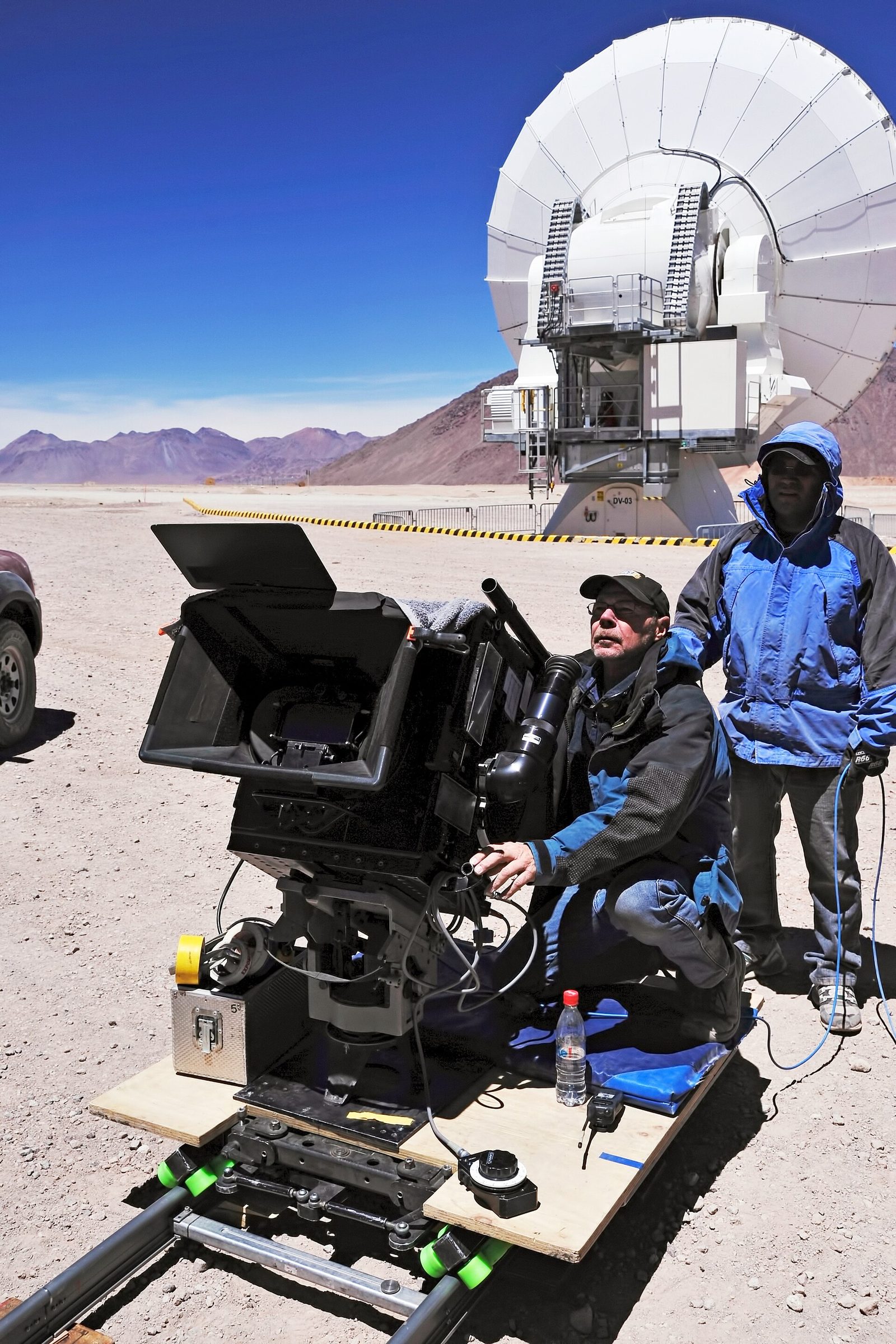
Pulling a frame that size through a projector fast enough to run at 24 frames per second, and doing it without tearing the film, was the problem that made IMAX possible or impossible. The answer came from an Australian engineer, Ron Jones, whose rolling loop mechanism IMAX acquired and refined. Instead of a claw yanking the film forward one frame at a time, the rolling loop feeds film horizontally around a rotor, with a wave, or loop, of film travelling around the drum and depositing each frame gently against the gate, where it is held flat by vacuum.
The cameras are a different story. The IMAX camera is a horizontal-feed 65mm machine with a vacuum pressure plate that holds the negative dead flat during exposure, which is a large part of why the images are so sharp, and a large part of why the cameras are so loud. Over the decades the company built a small family of bodies, including the MKIII and, later, the MSM 9802, which became the workhorse of the narrative era. Everything about them is heavy. An MSM 9802 body weighs around 23 kilograms before a lens or magazine, and a full 1,000-foot load runs a little under three minutes. The mechanism produces enough noise that dialogue recorded on set is generally unusable.
Museums, Volcanoes and Orbit
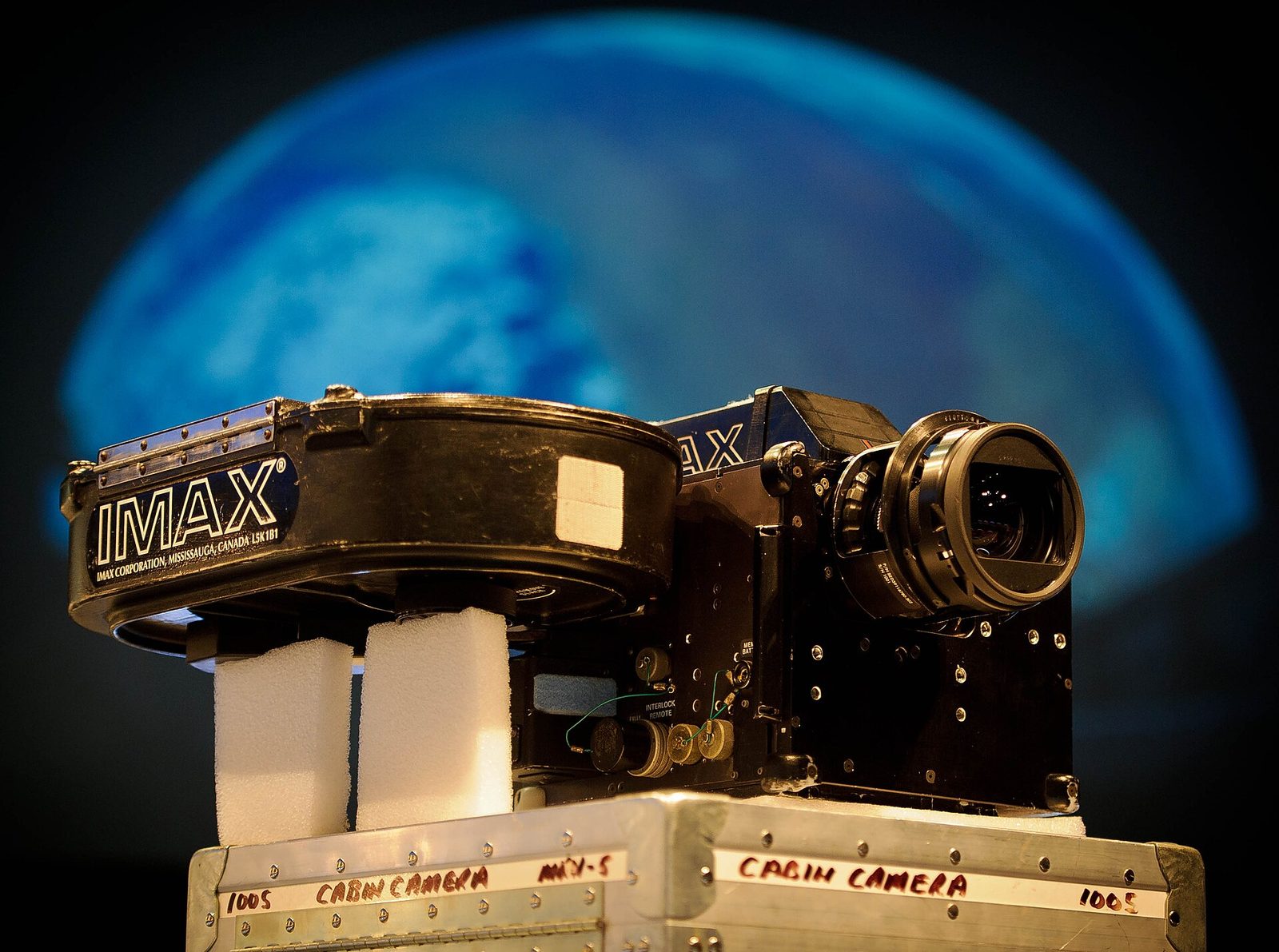
IMAX spent its first thirty years as a format for institutions rather than studios. Theatres were built into science centres and museums, and the films were forty-minute documentaries about oceans, canyons and animals. The format found its purest expression in space. Hail Columbia, released in 1982, was the first of a run of documentaries built around the Space Shuttle programme. For The Dream Is Alive in 1985, narrated by Walter Cronkite, NASA astronauts including Sally Ride and Kathryn Sullivan were trained to operate an IMAX camera on orbit and shot footage of their own missions. Later films such as Blue Planet, Destiny in Space and Mission to Mir extended the idea, and the images of Earth those crews brought back remain some of the most-seen large-format footage ever exposed.
Nolan, Pfister and The Dark Knight
The turn came in 2008. Christopher Nolan had been impressed by an IMAX blow-up presentation of Batman Begins and, with cinematographer Wally Pfister, ASC, decided to shoot key sequences of The Dark Knight natively in 15/70, cutting them together with anamorphic 35mm. Neither had shot IMAX before. They worked with MSM 9802 and MKIII bodies, planned a handful of action set-pieces around them, and lived with a camera weighing around 75 pounds with a lens, no usable production sound and a three-minute clock on every roll. Roughly half an hour of the finished film was captured in the format. It was the first time a major studio narrative feature had used IMAX cameras for original photography, and the opening bank heist, seen on a full-size IMAX screen with the aspect ratio expanding to fill the frame, changed what audiences expected from a blockbuster.
Pfister continued the approach on The Dark Knight Rises in 2012, and when Hoyte van Hoytema, ASC, FSF, NSC took over as Nolan's cinematographer, the proportion of IMAX photography kept climbing. Around a third of Interstellar in 2014 was shot in 15/70, alternating with 35mm anamorphic. Dunkirk in 2017 pushed it to roughly 70 percent, with 5-perf 65mm Panavision cameras covering dialogue scenes the noisy IMAX bodies could not. Oppenheimer in 2023 went further still, and for its black-and-white sequences Kodak manufactured a 65mm version of its Double-X stock that had never existed before, specifically for the IMAX and Panavision System 65 cameras.
Scarcity as a Creative Constraint
All of this was done with a fleet that is, by any normal standard, tiny. IMAX has never published a working inventory, but the number of 15/70 cameras ever built is generally reckoned at a couple of dozen across all models, including 3D rigs and documentary bodies that are effectively retired, and the number in regular feature service is in the single digits. When a production books IMAX cameras, it is often booking most of the ones that exist.
That scarcity finally forced new manufacturing. In 2022 IMAX announced a programme to build a new generation of 65mm film cameras, in collaboration with Kodak, Panavision and FotoKem, with Nolan and Jordan Peele among the filmmakers advising on the specification. The result, which IMAX has named the Keighley, made its debut on Nolan's The Odyssey, the first feature shot entirely in the 15/70 format. The new body is built from scratch, carries a modern LCD interface and, in IMAX's own figures, runs around 30 percent quieter than the older cameras, with a redesigned blimp that makes synchronised dialogue recording realistic for the first time. It is still enormous, close to 400 pounds fully rigged by Nolan's account, but for the first time more than one production can shoot IMAX film at once.
What It Means for the Rest of Us
Here is the reality for anyone reading a used-gear journal: you cannot buy an IMAX camera. They have never been sold to the public, they do not appear on the secondary market, and the company controls every body it has ever built. Productions get them by going to IMAX directly, usually with a studio behind them and a release plan that includes the few dozen theatres worldwide equipped to project 15/70 film. Panavision, as IMAX's long-standing partner on lenses and support, is part of that conversation, but the cameras themselves never leave the corporation's custody.
What the rest of the industry inherited is the appetite. The Alexa 65, which ARRI announced in September 2014 and offered through ARRI Rental only, was a direct answer to the demand Nolan's films had created for a large-format look without the noise and the three-minute loads. Its sensor is sized to the 5-perf 65mm frame, and much of its lens line descends from glass made for the Arriflex 765 and Panavision's System 65 film cameras. Every large-format digital camera since sits somewhere on the road IMAX opened.
And 65mm film itself is not out of reach. Panavision's System 65 and the Arriflex 765 remain in rental inventories and have worked alongside the IMAX cameras on Dunkirk, Oppenheimer and The Odyssey. If the used market has anything of IMAX to offer, it is the lenses, the heads and the accessories built for the format's 65mm cousins, along with a generation of cinematographers who learned that the biggest frame in cinema is worth every kilogram it costs to carry.