Where it came from
By the late 1990s, high-definition television was a broadcast standard in search of a purpose. Sony had been building HD cameras and recorders for years, and its engineers understood that television was a limited market for equipment this expensive. Feature films were the prize. The obstacle was frame rate: television HD ran at 60 fields or 30 frames a second, while a movie runs at 24. A camera that wanted to be taken seriously on a film set had to shoot 24 frames per second in true progressive scan, so that each frame was a complete picture and the footage could be transferred to film without strange motion artifacts.
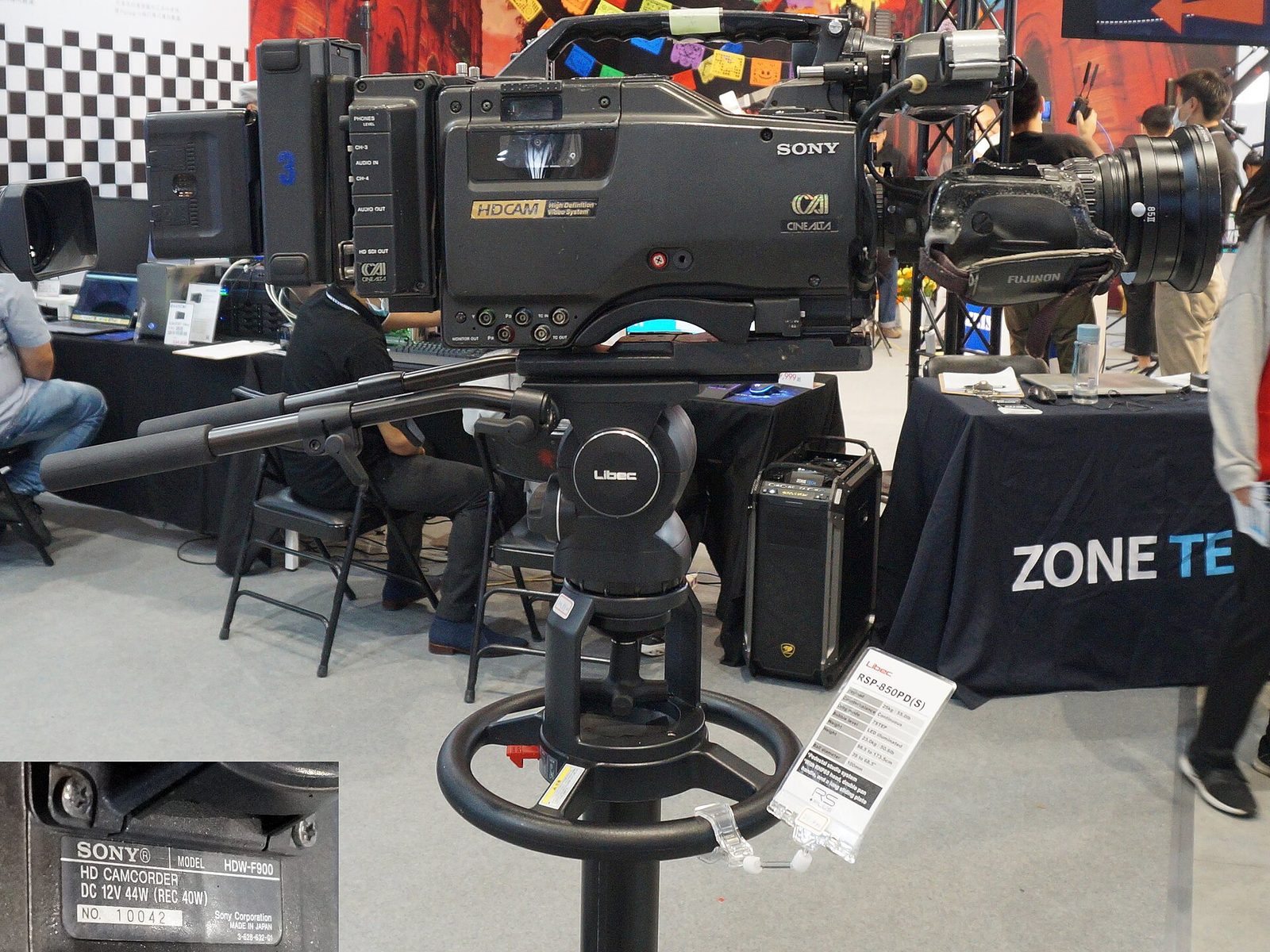
Sony set about building one, working with Panavision, a company that knew what cinematographers expected of a camera body and, more to the point, of its lenses. In June 1999 George Lucas announced that the next Star Wars film would be shot entirely on digital equipment, and the camera at the center of that announcement was the Sony HDW-F900, the first product in what Sony named the CineAlta line. Panavision sold its own modified version as the HD-900F. It was an unusual moment: a director with a reputation for pushing technology had effectively put his name behind a prototype.

What made it different
The F900 looked like a television camera because it was one, a shoulder-mounted camcorder in the tradition of the broadcast ENG cameras that came before it. Inside were three 2/3-inch CCD sensors behind a prism block and a B4 lens mount, the same mount used on studio and field video lenses. It recorded onto HDCAM tape, a compressed high-definition format that stored the picture at 1440 x 1080 rather than a full 1920 x 1080. Its important feature was the menu of frame rates: 24, 25 and 30 frames per second progressive, along with 50 and 60 interlaced fields for broadcast work.
That list of numbers is the whole story. The F900 did not out-resolve 35mm film, and nobody seriously claimed it did. What it offered was a workflow: no lab, no scanning, no waiting on dailies, and tape stock that cost a small fraction of the price of motion picture negative. A director could play back a take on a monitor immediately and shoot as many takes as the schedule allowed. The camera weighed roughly 18 pounds, heavier than most film-era handheld cameras, and it was frequently fitted with cine-style lenses and matte boxes so that it could behave like a film camera on a stage.
Who used it and what they shot
The marquee credit is Star Wars: Episode II, Attack of the Clones, released in 2002, with David Tattersall as director of photography. It was the first major Hollywood production shot entirely on digital equipment, and it carried an enormous amount of visual effects work, which was precisely the sort of film that benefited from a digital image that could move directly into a computer.
The F900 was not only a Lucasfilm tool. Robert Rodriguez, always an early adopter, shot Spy Kids 2 and Once Upon a Time in Mexico with it. In Russia, Tilman Büttner used an F900 for Alexander Sokurov's Russian Ark, recording a single unbroken take in the Hermitage to a hard-disk recorder rather than to tape, which would have been impossible on film. Lars von Trier and cinematographer Anthony Dod Mantle shot Dogville and Manderlay on the camera, and Michael Haneke's Caché, photographed by Christian Berger, was another notable European credit. Steven Soderbergh used Sony CineAlta cameras for Bubble. Michael Mann's Collateral combined the F900 with the Thomson Viper for its night-time Los Angeles photography, a pairing that showed what digital cameras could do in low light that film could not.
A smaller, quieter group of independent filmmakers, horror directors and television producers used the camera too. Session 9, a 2001 psychological horror film shot in an abandoned Massachusetts asylum, is a good example of how an unflattering sensor and a low budget could be turned into atmosphere.
Its rivals and what replaced it
The F900 had company almost at once. Panasonic's Varicam arrived with a different philosophy, using DVCPRO HD tape and variable frame rates for speed effects. Thomson's Viper recorded uncompressed data to disk. Sony responded by refining the line: the HDC-F950 followed in 2003 and was used on Revenge of the Sith, offering improved color handling and a dual-link output for recording outside the tape deck. The F900R updated the camera again in the middle of the decade.
The deeper change was the sensor. The F900 used the same 2/3-inch chip size as a television camera, which meant a depth of field far deeper than film and a look that many cinematographers disliked. Sony and Panavision eventually answered with cameras built around a single large Super 35-sized sensor, and Sony's F23 and F35 carried the CineAlta name forward. By the time ARRI's Alexa arrived, the arguments about whether digital could look like film were largely settled, and a tape-based, 2/3-inch camera had become a historical artifact.
Why it still matters
It is easy to dismiss the F900 for what it was not. It was not a pretty camera, and it was not a faithful substitute for film. Its images, with their clipped highlights and electronic edge, are an immediately recognizable look of the early 2000s. But it proved a commercial point. A feature film could be shot, edited and finished without film at any stage, and audiences would pay to see it. Every digital cinema camera since carries a line of inheritance from the moment the F900 was brought onto a Hollywood set.
On the used market today
A camera that once carried a six-figure price now changes hands for a small fraction of that, and F900s and their variants turn up regularly through rental house clear-outs and broadcast liquidations. They are well suited to filmmakers who want the soft, pre-2005 video texture and an HD-SDI output. The things to check are straightforward: the hours on the head drum and tape transport, since HDCAM decks and camcorders are mechanical devices that wear; the condition of the CCD blocks, which can show dead pixels or smear; the viewfinder and its cable; and whether the camera has its original battery plate and a working lens. HDCAM tape is still manufactured in limited quantity, but the machines that play it are aging, so a buyer should confirm that a working deck is available for ingest before committing. Treat a good F900 as a piece of film history that still functions, and price it accordingly.