Where it came from
VistaVision was a response to a problem Hollywood could not solve with a bigger screen alone. In the early 1950s television was draining theatres, and the industry's answer was spectacle: Cinerama's three-projector panorama, then CinemaScope's anamorphic squeeze. Paramount's camera department, under John R. Bishop, took a different route. Rather than stretching a small frame across a wide screen, it made the frame itself larger. The studio announced the system in 1954, and the first VistaVision feature to reach theatres was White Christmas.
The trick was to turn the film on its side. In an ordinary 35mm camera the stock runs vertically and each frame is four perforations tall. In VistaVision it runs horizontally through the gate, and each frame spans eight perforations, giving a negative roughly 37 by 25 millimetres, about twice the area of a standard 35mm frame. Crews called it the “Lazy 8” for the shape the frame made on the film. The idea was not entirely new; the ASC Museum notes that Paramount's engineers adapted the layout of a 1920s two-colour camera from the Stein company, turning it on its side and removing the divider between two frames.
What made it different
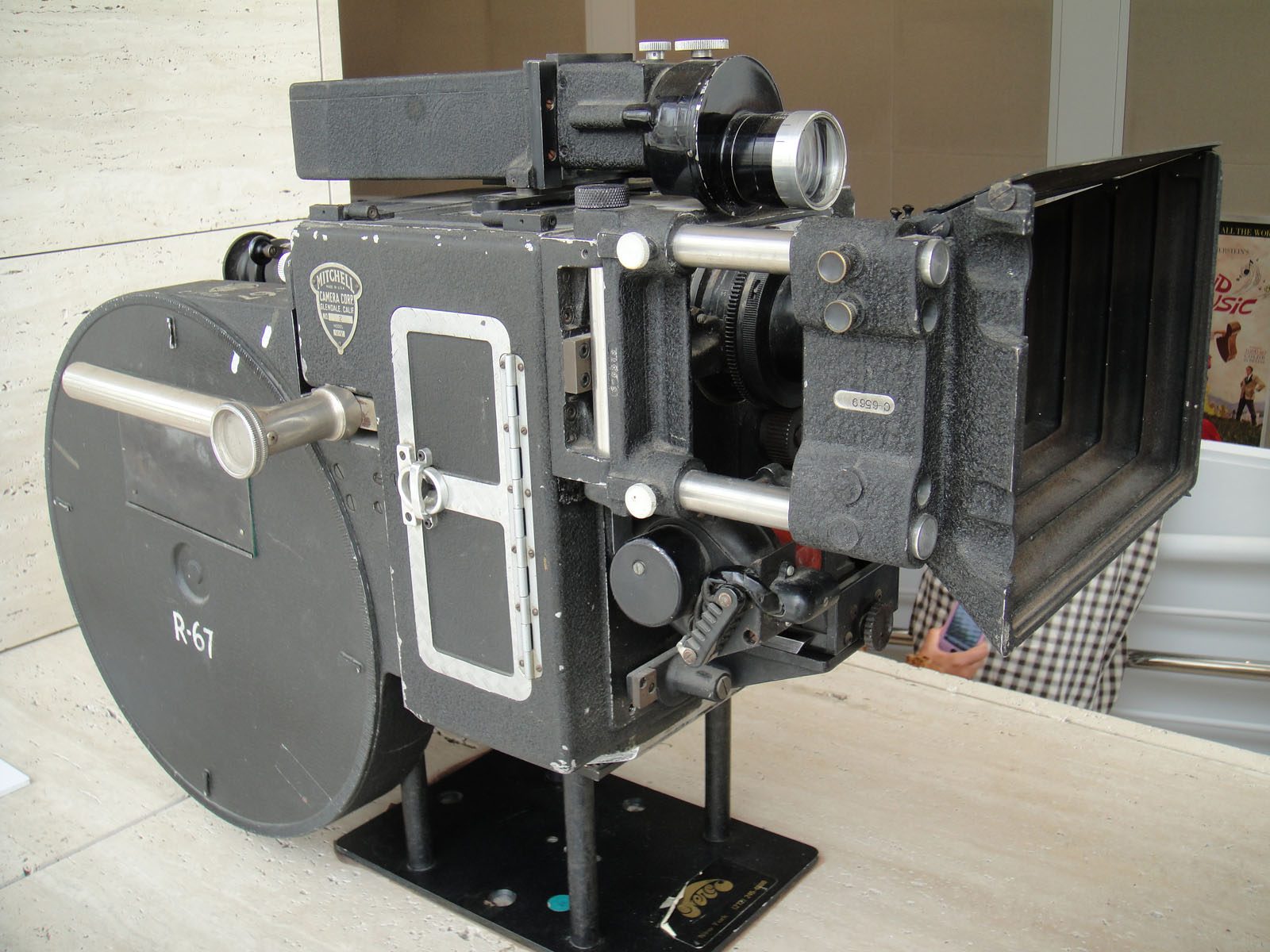
Everything about VistaVision followed from that larger negative. More silver halide per frame meant finer grain, higher resolution and smoother tonality, which mattered enormously in the early days of Eastmancolor, when 35mm negatives were still comparatively soft and grainy. Theatres could show the film in its native form on special horizontal projectors, but most never bothered. Instead, labs optically reduced the VistaVision negative to a conventional vertical 35mm print, usually framed at 1.66:1 or 1.85:1, and the benefit arrived on screens everywhere as a notably clean, sharp image without any new equipment in the booth.
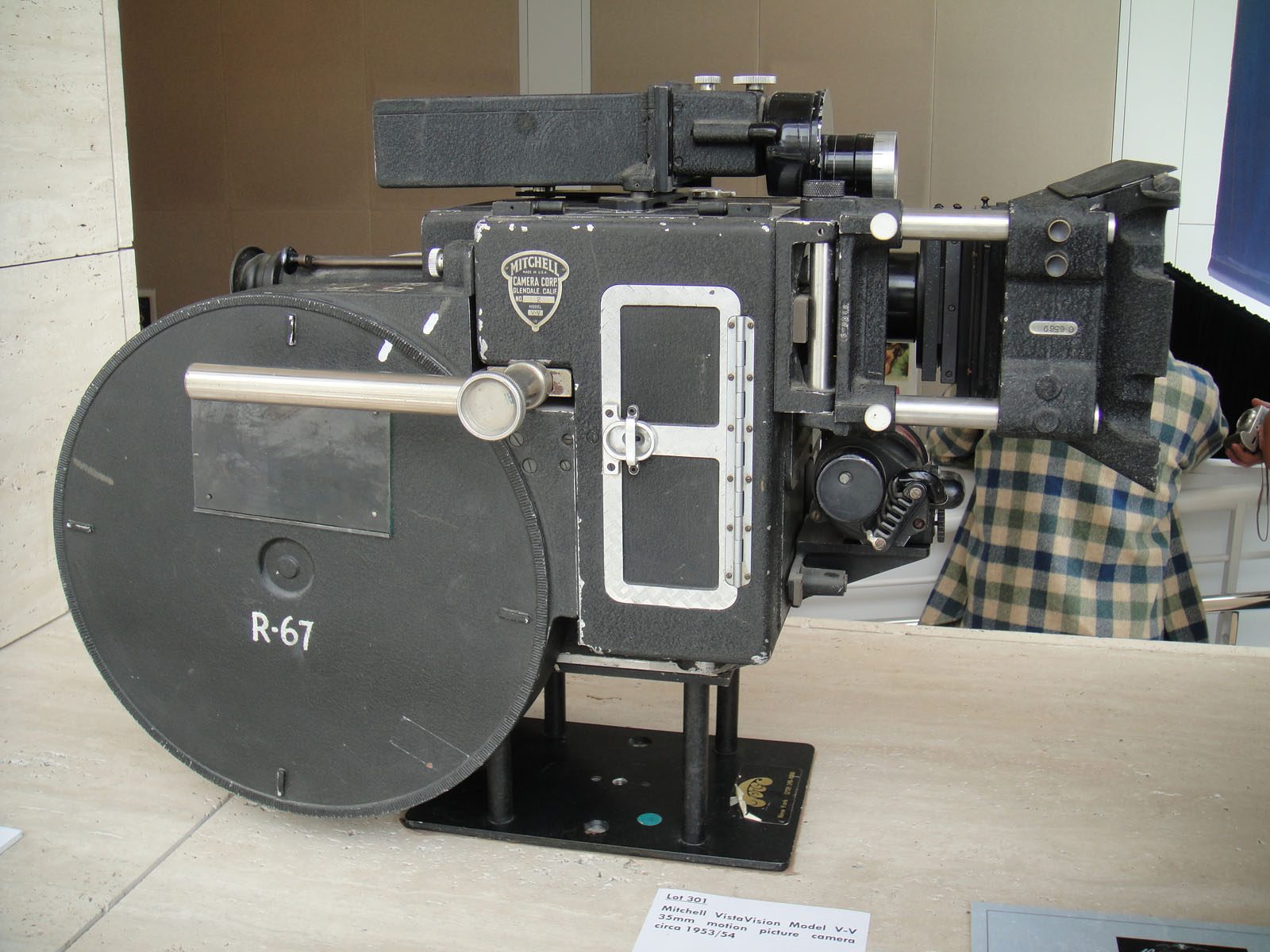
The cameras were built around the format. The standard machine was the Mitchell Model V-V, a big, blimped box with a horizontal magazine, a reflex finder and the familiar Mitchell movement, adapted to pull eight perforations at a time. It was heavy, loud without its housing and hungry for film: a VistaVision camera ate stock at twice the rate of a normal 35mm one, which is part of the reason the format was always expensive to run.
Who used it and what they shot
Paramount's own roster made the case first. Loyal Griggs, ASC, shot White Christmas and later Cecil B. DeMille's The Ten Commandments (1956) in the format. Alfred Hitchcock, under contract to Paramount, became its most famous customer, using it for To Catch a Thief (1955), the remake of The Man Who Knew Too Much (1956), Vertigo (1958) and North by Northwest (1959). Robert Burks, ASC, shot the Hitchcock pictures, and the ASC Museum credits the Model V-V in its collection as the type of camera he used on North by Northwest. Other studios licensed or imitated the system, and John Ford's The Searchers (1956) at Warner Bros. is among the best-known non-Paramount examples. The Hollywood run is usually said to have ended with Marlon Brando's One-Eyed Jacks (1961).
It is worth saying plainly that VistaVision is a format, not a single camera. Mitchell's V-V was the workhorse, but the family also included high-speed cameras, process and background-plate cameras, and a number of one-off machines built in studio machine shops. Those cameras mattered later for a reason nobody planned for in 1954.
Its rivals and what replaced it
VistaVision never lost on picture quality. It lost on economics and convenience. CinemaScope and, increasingly, Panavision's anamorphic lenses delivered a widescreen image on ordinary vertical 35mm cameras, with no doubled film cost and no special labs. Eastmancolor and then finer-grained stocks closed much of the quality gap that had justified the big negative in the first place. Other large-format systems, among them Todd-AO and Technirama, offered alternatives, and Paramount itself moved to Technirama in the early 1960s. By the end of the decade the horizontal cameras were largely idle.
They were rescued by visual effects. Optical compositing, the process of combining several film elements into one shot, loses quality with every generation, and a bigger original negative leaves more room for those losses. When George Lucas set up Industrial Light & Magic for Star Wars (1977), the shop used VistaVision cameras for effects photography, among them the high-speed unit that photographed miniature work including the Death Star explosion, with Richard Edlund, ASC, running the visual effects unit. For years afterward, the format that had failed as a way of shooting actors survived as a way of shooting models, mattes and plates.
Why it still matters
In the past few years VistaVision has done something rare: it has come back as a way of shooting actors. Lol Crawley, ASC, BSC, used it for large parts of Brady Corbet's The Brutalist (2024) and won the Oscar for cinematography. Michael Bauman shot most of Paul Thomas Anderson's One Battle After Another (2025) on it, and Yorgos Lanthimos and Robbie Ryan used it on Bugonia (2025). More productions have since announced it. The revival has been practical and sometimes difficult: crews have found cameras in the hands of collectors, museums and rental houses, and Bauman has said that putting such a camera on a Steadicam raised the question of whether it could hold up. Still, the appeal is the old one, a large negative that gives a picture a depth and grain structure that smaller formats do not quite reproduce. Digital makers have noticed, and large-format sensors such as RED's V-Raptor 8K VV are named for the same idea.
On the used market
A working VistaVision camera is not an everyday purchase. Surviving Mitchell V-V bodies are scarce, were built in small numbers, and tend to sit in museums, effects houses and private collections. Prices reflect that: a camera associated with The Ten Commandments and the Hitchcock films reportedly sold for around $65,000 at auction in 2015, and demand has only grown since the recent revival. Most examples of the era are mechanically sound if they have been kept up, but buyers should expect to check the movement and registration, the condition of the gate and pressure plate, the integrity of the magazines and the lenses, and whether the camera has been modified for a particular purpose. Good service by someone who knows the type matters more than cosmetics.
The film itself is the other half of the cost. Eight-perf stock must be spooled, loaded and processed, and few labs handle it routinely, so a buyer should confirm where the negative will be developed and scanned before committing to the camera. For collectors, it is the rare piece of 1950s equipment that is both a museum object and, increasingly, a working tool.